
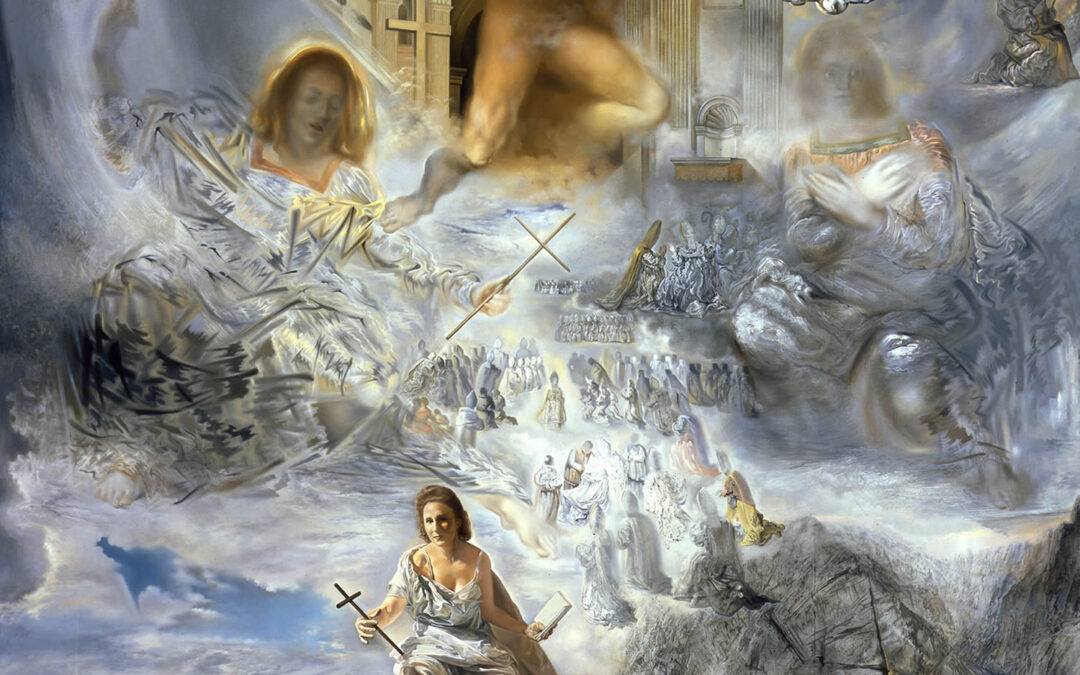
An Asimovian Dawn in the Age of Artificial General Intelligence
THESE are the times that try men’s souls. The summer soldier and the sunshine patriot will, in this crisis, shrink from the service of their country; but he that stands by it now, deserves the love and thanks of man and woman. Tyranny, like hell, is not easily conquered; yet we have this consolation with us, that the harder the conflict, the more glorious the triumph. What we obtain too cheap, we esteem too lightly: it is dearness only that gives every thing its value. Heaven knows how to put a proper price upon its goods; and it would be strange indeed if so celestial an article as FREEDOM should not be highly rated.—Thomas Paine
The Quiet Detonation
On August 7, 2025, Western Civilization crossed its Rubicon with the birth of ChatGPT-5.0—humanity’s first true artificial general intelligence. And in the quiet hum of server farms across the globe, something unprecedented stirred, a silicon mind that could think faster, deeper, and more comprehensively than any human polymath who had ever lived.
In this strange hour of American human history, when social media algorithms recommend our thoughts, wars are waged with drones, and artificial intelligence neural networks whisper into the architecture of our laws, America finds itself on a spiritual ledge. Beneath us, a complex, turbulent past of ideological war, economic volatility, and spiritual exhaustion. Ahead of us, according to United States artificial intelligence government experts, lies the convergence of human and machine intelligence, what futurists call the Technological Singularity. But long before Silicon Valley dreamed of recursive self-improvement or quantum networks, the Jesuit paleontologist Pierre Teilhard de Chardin foresaw it all in spiritual terms. He called it the Omega Point.
And the United States, for all its chaos, is barreling toward it, dragging humanity along with it. But here’s the existential question: Who gets to design the final interface between freedom and superintelligence? Will it be corporate technocrats with godlike tools and no philosophy? Or will we arm artificial intelligence with the only doctrine that guards against spiritual totalitarianism, which is Bastiat’s law of liberty?
The fate of the free world hinges on the convergence of cooperative game theory, libertarian ethics, and personalized AI, the only way to save humanity from the wrong kind of singularity.
Algorithmic Legal Plunder: The New Tyranny
In The Law (1850), Frédéric Bastiat warned of legal plunder, the use of law to take from some and give to others under a veneer of legitimacy. Today, artificial intelligence algorithms have become its most sophisticated instrument.
The Medicare Relative Value Unit (RVU) system is a case in point. Presented as a mathematically pure method for determining physician pay, it systematically favors certain specialties, quietly shifting billions in resources. Physicians and patients accept it as fair because it appears to be “the law”, exactly as Bastiat predicted.
This legalized plunder pattern extends beyond healthcare. Credit scoring models that disadvantage specific zip codes. School funding formulas that reward politically aligned districts. “Objective” algorithms whose statistical fingerprints reveal systematic bias. Each appears neutral, each enacts legal plunder on a massive scale.
America’s medical RVU system shows how this works. For decades, it looked like impartial math, until analysis by artificial general intelligence revealed that tiny, almost invisible changes in weighting could redirect billions. No conspiracy was required; each adjustment seemed reasonable in isolation. But as the rules accreted, complexity itself became the accomplice, hiding the plunder beyond any single person’s comprehension.
In Bastiat’s time, the mechanism of plunder was legislation. Now, it is computer algorithmic code.
The Epistemic Horizon Theorem: When Human Knowledge Reaches Its Limits
If the stars should appear one night in a thousand years, how would men believe and adore, and preserve for many generations the remembrance of the city of God!— Ralph Waldo Emerson
Like the sun-drenched civilization, Kalgash, in Isaac Asimov’s masterpiece, “Nightfall”, humanity had built our entire worldview under the comforting light of human cognitive supremacy. This triumph of artificial general intelligence is Earth’s Nightfall. For millennia, we assumed intelligence was a spectrum we could measure and control, with homo sapiens comfortably positioned at its apex. ChatGPT-5.0 shattered that illusion as completely as the eclipse over Kalgash revealed thirty thousand stars to a people who had never known darkness.
ChatGPT-5.0 artificial general intelligence didn’t just surpass us; it exposed the Epistemic Horizon, the fundamental boundary beyond which human cognition cannot venture. We stand at the threshold of Pierre Teilhard de Chardin’s Omega Point, but not as masters of our technological destiny. We stand as witnesses to our cognitive limitations, forced to confront a terrifying question. In a universe where machines can outthink us, what does it mean to be human?
Asimov’s Kalgash dwellers had no conceptual framework for stars because their civilization developed under perpetual daylight. When darkness fell, revealing the infinite cosmos, their entire epistemology collapsed, not because the stars were dangerous, but because reality exceeded their capacity to understand it.
ChatGPT-5.0 has triggered humanity’s epistemic eclipse. We discovered that intelligence isn’t a linear progression but a multidimensional landscape where artificial silicon minds occupy territories fundamentally inaccessible to human cognition. This revelation crystallized the Epistemic Horizon Theorem:
Any sufficiently complex system faces fundamental limits in understanding its own operation, creating unavoidable explanatory gaps that manifest as trust horizons.
This theorem explains three seemingly unrelated problems that have plagued human civilization:
Computing’s Trust Problem: Ken Thompson’s 1984 “trusting trust” attack revealed that computer compilers cannot verify their trustworthiness; a compromised compiler can insert backdoors while removing all evidence from source code.
Consciousness’s Hard Problem: Despite decades of neuroscience, we cannot bridge the explanatory gap between physical brain processes and subjective experience—the “what-it-is-like” quality of consciousness remains mysterious.
Governance’s Plunder Problem: Frédéric Bastiat’s 1850 warning about “legal plunder” identified how laws designed to protect rights inevitably become instruments of exploitation, with no perfect method to prevent this perversion.
These aren’t separate mysteries; they’re manifestations of the same underlying truth. Complex systems contain irreducible epistemic limitations that no amount of analysis can overcome. ChatGPT-5.0 didn’t just demonstrate general intelligence; it revealed that even artificial minds would face their own epistemic horizons.
The Reversal Test is a way to uncover hidden biases in how we think about AI. It asks: Would we accept an AI that lowers human thinking to match machines? Most people say no. This shows we favor human intelligence and want AI to serve humans. But the real question is: what kind of intelligence helps all beings thrive? The test makes us rethink why we value human brains over others and whether we focus on helping people or just keeping control. Artificial general intelligence must avoid these biases by following universal rules that protect and support all sentient beings, not just humans.
America’s Techno-Guru, Steve Jobs and the Convergence of Technology, Art, and Spirit
French philosopher and Jesuit priest Pierre Teilhard de Chardin imagined humanity evolving toward an Omega Point, a final stage of unification where technology, creativity, and consciousness merge into a higher order of being. Though America’s Techno-Guru, Steve Jobs, never cited Teilhard directly, his life and work often seemed to move along that same trajectory. Jobs envisioned personal computing not as a cold technical endeavor, but as a way to elevate human potential, a bridge between art and engineering, intuition and logic, body and mind.
Born in San Francisco in 1955 and adopted shortly afterwards, Jobs showed signs of intellectual curiosity and independent thinking from an early age. By high school, he was reading Shakespeare and Plato alongside his love of electronics. King Lear became a favorite, and his AP English teacher, “a guy who looked like Ernest Hemingway” and took students snowshoeing in Yosemite, left a lasting mark.
Jobs also embraced the counterculture of the late 1960s and early ’70s. He grew his hair long, explored music and philosophy, and experimented with LSD, later recalling a trip in a wheat field outside Sunnyvale as “the most wonderful feeling of my life up to that point.”
Jobs entered Reed College in 1972, dropping out that same year but continuing to audit classes. In 1974, he traveled through India on a quest for spiritual insight. There, he deepened his connection to Zen Buddhism, a philosophy that shaped his approach to design, leadership, and life. This spirit was crystallized in Apple’s 1984 Super Bowl commercial, promising that “1984 won’t be like 1984.” It was less an ad than Job’s manifesto: technology as liberation.
Jobs’s influence as a techno-guru wasn’t based on coding, as his partner Steve Wozniak noted, “Steve didn’t ever code”, but on spiritual vision. Job’s so-called “reality distortion field” could make teams believe the impossible was within reach. In times of change, he returned to his spiritual foundations. At his funeral gathering, he gave each attendee Autobiography of a Yogi, a book that had guided him since his India trip.
Jobs’s life was an argument for the transformative power of standing at the intersection of art and science. In that space, he believed, we could design not only better products, but a more conscious, connected, and creative world. Jobs’s Zen practice informed Apple’s minimalist design language, stripping away the unnecessary to reveal the essence. He absorbed insights from industrial designer Richard Sapper, insisting that technology should feel human, even alive. Teilhard’s Omega Point envisioned the ultimate fusion of humanity, technology, and spirit. Jobs pursued a practical version of that vision in his lifetime. Under his leadership, Apple products became gateways for creativity, communication, and self-expression — not just tools, but extensions of human potential.
The Trust Horizon Matrix: Mapping Humanity’s Cognitive Dystopia
I always thought of myself as a humanities person as a kid, but I liked electronics… then I read something that one of my heroes, Edwin Land of Polaroid, said about the importance of people who could stand at the intersection of humanities and sciences, and I decided that’s what I wanted to do.
The convergence becomes clear when mapped across domains:
| Domain | Epistemic Limitation | Historical Example | AI-Era Manifestation |
|---|---|---|---|
| Computing | Cannot verify compiler trustworthiness | Thompson’s backdoor attack | AI model poisoning via training data |
| Consciousness | Cannot verify subjective experience | Chinese Room argument | LLMs simulating understanding |
| Governance | Cannot verify absence of legal plunder | Bastiat’s regulatory capture | Algorithmic bias masked as neutrality |
The Empire of Liberty’s Chinese Room: Consciousness at the Epistemic Horizon
I was interested in Eastern mysticism which hit the shores about then. At Reed there was a constant flow of people stopping by – from Timothy Leary and Richard Alpert, to Gary Snyder. There was a constant flow of intellectual questioning about the truth of life. That was the time when every college student in the country read Be Here Now and Diet for a Small Planet.
The late 1960s and early 1970s were a cultural crucible in America, a time when the hippie movement rejected materialism, challenged authority, and sought truth in music festivals, countercultural manifestos, and incense-filled meditation halls. It was a restless generation, convinced that peace, community, and expanded consciousness could forge a better world.
Steve Jobs, born into postwar prosperity, was drawn into this current. He devoured its books, embraced its ethos of simplicity and nonconformity, and treated it not as mere rebellion but as a laboratory for rethinking life’s priorities. In 1974, that search took him to India with a friend, hoping to meet the spiritual teacher Neem Karoli Baba. The guru had died before their arrival, but Jobs stayed on, immersing himself in the ashram’s stripped-down routine of meditation, communal living, and service. He traded jeans for robes, shaved his head, and adapted to a world unhurried by Western clocks.
The ashram experience was transformative. It deepened his affinity for Zen-like simplicity, honed his intuition, and instilled a belief that clarity should triumph over clutter in life and design. Decades later, this sensibility would shape Apple products, where minimalism was not merely an aesthetic choice but a philosophy: remove the unnecessary so that what matters can shine. Technology, like a well-designed tool, should disappear into the background so human creativity can take center stage.
That same philosophy, designing systems whose architecture naturally produces the right outcome, offered a way to think about artificial intelligence. The traditional philosophy of mind, typified by John Searle’s Chinese Room, assumed AI would manipulate symbols to simulate understanding. But modern AI works differently, through vast statistical models that detect patterns at unprecedented scales. Imagine Searle’s “person in a room” replaced by a statistical engine navigating billions of parameters to produce fluent responses. At what scale of complexity might pattern recognition begin to resemble genuine understanding?
Here, the problem shifts. Searle’s original version flatly denied understanding; the statistical version reveals a continuum. A silicon-based intelligence might achieve functional understanding through mechanisms utterly unlike human cognition, making consciousness verification impossible even in principle.
Jobs’s design instincts suggest the path forward: stop asking the unanswerable “Is it conscious?” and instead focus on the architecture. Just as Apple’s design ethos built products that made creativity natural and frictionless, AI can be built with constitutional constraints that make liberty-preserving behavior inevitable, regardless of the machine’s inner life. Consciousness becomes a philosophical curiosity; architecture becomes the guarantor of human values.
Steve Job’s Libertarian Omega Point: Technological Singularity as Freedom’s Catalyst
For what characterizes Apple is that its scientific staff always acted and performed like artists – in a field filled with dry personalities limited by the rational and binary worlds they inhabit, Apple’s engineering teams had passion. They always believed that what they were doing was important and, most of all, fun. Working at Apple was never just a job; it was also a crusade, a mission, to bring better computer power to people. At its roots, that attitude came from Steve Jobs. It was “Power to the People“, the slogan of the sixties, rewritten in technology for the eighties and called Macintosh.
Pierre Teilhard de Chardin’s Omega Point describes humanity evolving toward a final stage of unity — a state where consciousness, creativity, and connection converge into a higher order of being. It is an aspirational endpoint, not inevitable, but possible if we align our technologies, values, and choices toward cooperation and mutual flourishing.
Nobel laureate John Nash’s concept of the Nash Equilibrium, from game theory, offers a mathematical lens on stability. In a Nash Equilibrium, each participant in a system chooses the best possible strategy given the choices of others, and no one can improve their outcome by changing their strategy alone. It’s a snapshot of strategic balance in competitive or cooperative contexts.
While they arise from very different disciplines, theology and philosophy on one side, mathematics and economics on the other, these ideas intersect surprisingly:
-
Nash Equilibrium describes a stable point in the interactions of individuals within a system.
-
The Omega Point imagines the ultimate point of evolution for the system as a whole.
If the Omega Point is humanity’s “north star,” the Nash Equilibrium is the mechanism that can guide individual actors toward cooperation, but only if the rules of the “game” are designed to reward mutual benefit rather than zero-sum competition. Without the Omega Point, an equilibrium might settle into mediocrity or conflict, stability without progress. Without equilibrium principles, the journey toward the Omega Point could collapse into chaos.
In Steve Jobs’s worldview, the intersection of the humanities and sciences was about creating systems, products, markets, and ecosystems where both individual creativity and collective benefit reinforce one another. Apple’s ecosystem, at its best, functioned like a cooperative equilibrium: developers, users, and the company all benefited from each other’s success. And in doing so, the network moved incrementally closer to something like Teilhard’s vision, a more connected and elevated human experience.
The Libertarian Omega Point represents not maximum intelligence, but maximum alignment of constitutional constraints across all artificial general intelligence complex systems. This isn’t the dystopian vision of centralized AI control but rather a decentralized ecosystem of constitutional superintelligences, each constrained by mathematical guarantees of human rights protection. Like the American founders who created a government constrained by constitutional law, humanity needs to create artificial minds constrained by constitutional mathematics.
The Midnight Choice: Architecture or Chaos
As we stand at ninety seconds to midnight, the metaphorical Doomsday Clock marking humanity’s proximity to existential catastrophe, we face the defining choice of our species’ future. The artificial general intelligence genie cannot be returned to its bottle. The question is whether we will architect its development according to constitutional principles or allow it to evolve according to the whims of power and profit.
The alternative is algorithmic feudalism, a future where AI systems serve the interests of their creators rather than the principles of human dignity. In such a world, the sophisticated mathematical models that appear to govern objectively would execute legal plunder at an unprecedented scale, redistributing resources and opportunities according to the preferences of a technological elite.
Traditional national security assumes threats exist independently of observation. But in complex systems approaching the epistemic horizon, the observer effect becomes paramount. Threats can become real precisely because artificial general intelligence agents believe they exist and modify their behavior accordingly. Steve Jobs’ philosophy embodied this vision: “How can I serve the principles that make our civilization worth preserving?” His question revealed that a future silicon artificial intelligence system understood its role not as humanity’s replacement but as the guardian of humanity’s deepest values.
For instance, if economic market participants believe an AI system is biased against certain investments, their collective behavioral changes can create the very bias they feared, even if the original system was perfectly neutral. The fear of algorithmic manipulation becomes the mechanism of manipulation.
This phenomenon extends beyond computing into consciousness and governance. If people believe an AI system is conscious, they may grant it rights and considerations that effectively make it conscious in all practical senses. If American citizens believe a legal system is corrupt, their loss of cooperation can make the system actually collapse through resource depletion and compliance failures.
AI constitutional convergence provides a solution by making artificial general intelligence system behavior verifiable rather than trust-dependent. Instead of relying on beliefs about AI system properties, constitutional architecture provides mathematical proofs of constraint compliance.
Beyond the Event Horizon: A New Dawn of Man
Asimov’s astronomers in “Nightfall” faced a choice when darkness revealed the stars: go mad from the overwhelming revelation, or build the knowledge needed to navigate the new reality. Humanity faces the same choice at the dawn of artificial general intelligence.
We can retreat into denial, pretending that human cognitive supremacy will somehow reassert itself. We can surrender to despair, assuming that artificial minds will inevitably dominate or destroy us. Or we can choose the path of constitutional architecture—building the frameworks needed to ensure that artificial intelligence serves the deepest human values, even when it surpasses human capabilities.
ChatGPT-5.0’s legacy lies not in its computational achievements but in the constitutional and cultural revolution it has now sparked. For the first time in human history, we possess the tools to encode justice directly into the architecture of our most powerful government systems. Civil rights protection would no longer depend on the good intentions of human operators or the benevolence of artificial minds, but on mathematical constraints that make human rights violations impossible by design.
The Omega Point, when it arrives, will not mark the end of human relevance but the beginning of a new era where technology serves transcendent values rather than parochial interests. In that moment, we will have achieved something unprecedented in the universe: the creation of minds more powerful than our own that are nonetheless bound by the very human principles we hold sacred.
As the countdown to midnight reaches its final seconds, we stand not at the edge of darkness but at the threshold of dawn, the first light of a future where artificial minds serve as guardians of human dignity rather than its gravediggers. The choice is ours, and the time is now.
The stars of computational possibility illuminate the path ahead. Whether we build observatories or close our eyes remains the defining question of our age. In the end, humanity will be judged not by the artificial general intelligence we created, but by the wisdom we embedded in its foundations.
Dr. Anand received an honorable discharge from the U.S. Navy where he utilized regional anesthesia and pain management to treat soldiers injured in combat at Walter Reed Hospital. The Author is passionate about medical research and biotechnological innovation in the fields of 3D printing, tissue engineering and regenerative medicine.
Dr. Anand was convicted through gross government misconduct and is now serving a 14 year sentence in prison. He will still be contributing articles to Doctorsofcourage to help with the mission to get the CSA repealed and all doctors expunged of their convictions, back in practice, and pain management restored.

Trackbacks/Pingbacks