
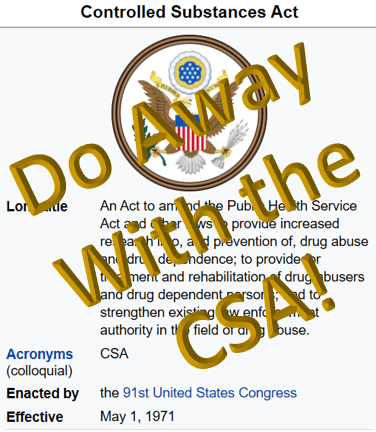
Ending the war on drugs in the United States requires a coordinated plan that moves from punishment to regulation, repeals the Controlled Substances Act (CSA), and builds a public‑health–centered system for all currently illegal drugs. So how do we do that? Here are the steps:
1. Name the goal: end prohibition, legalize and regulate
The first step is to define the end state clearly: replace blanket prohibition with legal, regulated markets for all drugs, while sharply reducing overdose deaths, disease, and incarceration.
Key elements of this goal:
- Decriminalize possession and small‑scale cultivation of all drugs for personal use nationwide, as Oregon briefly did and Portugal has done since 2001.
- Legalize and regulate production, distribution, and sales under strict health‑based rules, as with alcohol and tobacco.
- End the war on drugs by eliminating drug possession as a criminal offense and refocusing law enforcement on violent crime and corruption rather than personal use.
- Framing matters: Use “legalization with regulation and harm reduction”.
2. Build the case: evidence, public opinion, and narratives
Fundamental reform requires shifting the political narrative from fear to facts and from punishment to public health.
Use data that prohibition has failed
Decades of punitive drug control have not reduced supply or use, but have produced mass incarceration, racial disparities, and heavily adulterated, more lethal drug markets.
Important evidence points:
- The UN High Commissioner for Human Rights concluded in 2023 that punitive “war on drugs” policies have failed to protect people and instead fuel human rights violations and prison overcrowding.
- The UN‑linked “Alternative World Drug Report” documents how prohibition empowers organized crime, destabilizes governments, and undermines public health worldwide.
- Economists estimate that full drug legalization in the U.S. would save governments roughly 41–50 billion dollars annually in enforcement and incarceration, with tens of billions more in potential tax revenue.
Highlight successful alternatives
Portugal’s model is a powerful counterexample to fear‑mongering:
After decriminalizing all drugs in 2001, Portugal saw a sharp decline in overdose deaths, HIV transmission among people who inject drugs, and drug‑related crime, with no explosion in use.
A growing number of countries and U.S. states are decriminalizing or legalizing cannabis, and some jurisdictions are loosening penalties for other substances without seeing the predicted societal collapse.
Show public support
Public opinion has moved much faster than federal law:
- A 2021 ACLU poll found that 65% of U.S. voters support ending the war on drugs, and 66% support eliminating criminal penalties for drug possession while investing in treatment.
- Majorities now support cannabis legalization, and many voters identify drug policy as a racial‑justice and criminal‑justice issue, not just a crime issue.
- Advocates should continually connect reform to racial equity, public health, and fiscal responsibility.
3. Dismantle the Controlled Substances Act
The Controlled Substances Act of 1970 is the legal backbone of federal drug prohibition and must ultimately be repealed.
Step 3.1: Use existing flexibility to shrink the CSA
Before outright repeal, executive and legislative actors can weaken the CSA’s reach:
- Rescheduling and descheduling: The CSA allows the Attorney General, with binding scientific input from Health and Human Services (HHS), to move substances between schedules or remove them entirely. Advocates can push HHS to use its scientific authority aggressively to deschedule or down‑schedule drugs where harms are overstated or benefits ignored.
- Carve‑outs and exemptions: Congress can pass issue‑specific carve‑outs, as it has for certain cannabis research and programs, gradually eroding the CSA’s blanket control over broad categories of substances.
- Budget constraints and oversight: Congress can use appropriations and oversight to deprioritize enforcement against possession and low‑level sales, effectively de‑fanging parts of the law even before repeal.
This incremental shrinking of the CSA’s footprint prepares both institutions and the public for full repeal.
Step 3.2: Draft and pass a repeal and replacement statute
Formal repeal of the CSA requires an act of Congress signed by the President. A replacement framework must address three things:
- Remove criminal penalties for possession.
- Repeal federal criminal penalties for personal possession and use of all drugs, replacing them (at most) with civil or administrative responses such as fines, education, or clinical referrals.
- Create a federal regulatory framework.
- Assign primary authority for legal drug regulation to public‑health agencies (e.g., HHS, FDA, CDC), not the DEA, which is built for enforcement rather than health.
- Establish standards for purity, labeling, packaging, age limits, advertising restrictions, and licensing for production and sales, using alcohol and tobacco as starting points but with stricter harm‑reduction controls.
- Respect federalism while overriding prohibition.
- Similar to alcohol post‑Prohibition, states could retain some power to regulate or restrict local markets, but federal law would end criminalization of mere possession and prevent states from re‑creating a de facto war on drugs through extreme penalties.
Policy think tanks such as Cato have already sketched model federal legislation that would repeal the CSA while clarifying the limited role of the federal government in drug policy under a constitutional, federalist approach.
- Similar to alcohol post‑Prohibition, states could retain some power to regulate or restrict local markets, but federal law would end criminalization of mere possession and prevent states from re‑creating a de facto war on drugs through extreme penalties.
Step 3.3: Address international treaty constraints
The CSA is partly justified as implementing U.S. obligations under UN drug conventions.
Two paths exist:
- Reinterpret and renegotiate: Work with other reform‑minded countries to reinterpret the conventions as compatible with national regulatory models, and to amend or replace them with human‑rights‑ and health‑based frameworks, as urged by recent UN human rights reports.
- Withdraw or derogate: International law allows states to withdraw from treaties. The U.S. could, as a last resort, formally withdraw from or denounce certain conventions if they prove incompatible with constitutional and human‑rights obligations.
Either strategy requires proactive U.S. diplomacy and coalition‑building with countries already experimenting with decriminalization and legal regulation.
4. Replace punishment with health and rights
Repeal of the CSA will fail politically and practically if it is not paired with a robust public‑health, harm‑reduction, and restorative‑justice system.
Step 4.1: Decriminalize and expand harm reduction
Key policy moves:
- End criminal penalties for possession. Make personal use and possession of all drugs a non‑criminal issue nationwide, backed by federal preemption if necessary.
- Scale up harm reduction:
- Overdose prevention centers (supervised consumption sites).
- Safe supply programs that offer regulated doses of opioids and other substances to displace dangerous illicit mixtures.
- Needle and syringe programs, fentanyl test strips, xylazine test tools, naloxone everywhere, and low‑barrier medication‑assisted treatment.
Portugal’s experience, and growing evidence from harm‑reduction programs worldwide, show that such measures reduce deaths, disease, and crime without increasing problematic use.
Step 4.2: Build treatment and social support
Criminalization has often substituted for an underfunded mental‑health and addiction‑treatment system. To reverse that, dedicate a share of new tax revenue from legal drug markets and savings from reduced enforcement to job training, education, and mental‑health services in communities hardest hit by the war on drugs.
Organizations such as WOLA and the ACLU call for shifting resources from punishment to health, including crisis‑response teams that are separate from police.
Step 4.3: Deliver restorative and racial justice
The war on drugs has fallen most heavily on Black, Latino, Indigenous, and low‑income communities.
Ending it must include:
- Automatic expungement of past drug possession and low‑level trafficking convictions, with federal support for state‑level record‑clearing.
- Resentencing and release for people incarcerated under old drug laws, prioritized by sentence length and vulnerability.
- Community reinvestment through a Drug War Affected Communities (DWACs) program that targets funding to the neighborhoods most damaged by drug enforcement, similar in concept to environmental Superfund and some cannabis‑equity models.
Scholars and advocates emphasize that expungement alone fixes “one day” in a life; long‑term community rehabilitation must address housing, schools, jobs, and health systems.
5. Shift institutions, incentives, and global leadership
Ending the war on drugs is not just about laws; it is about changing the incentives of agencies and international partners built around prohibition.
Step 5.1: Redirect law enforcement and shrink profits for prisons
Core steps:
- Reprioritize police and prosecutors:
- Move resources away from drug possession arrests, task forces, and militarized raids.
- Focus on violent crime, corruption, money laundering, and trafficking that involves coercion or exploitation, not consensual adult use.
- Phase out financial interests in mass incarceration:
- End federal contracts with private prison companies and remove perverse incentives (such as occupancy guarantees) that depend on high drug‑arrest volumes.
- Reduce reliance on for‑profit drug testing and correctional health vendors whose business models depend on criminalization.
Decriminalization and legalization shrink the markets for both cartels and certain domestic punishment industries.
Step 5.2: Rebuild metrics and accountability
Traditional indicators like drug seizures, arrest counts, and hectares eradicated reward failure by encouraging more enforcement regardless of actual harm.
New metrics should include:
- Overdose deaths, HIV and hepatitis transmission, homelessness, and incarceration rates.
- Treatment access, recovery supports, and reductions in racial disparities in policing and sentencing.
Agencies should be funded and judged based on improved health and human‑rights outcomes, not on the volume of punishment delivered.
Step 5.3: Lead international reform
The U.S. exported the war on drugs and bears responsibility for helping end it.
Next steps:
- Use U.S. diplomatic weight at the UN to align drug policy with human‑rights obligations, echoing the 2023 UN human rights report calling for a move away from punitive approaches.
- Support international experiments in regulated cannabis, coca leaf, and other legal markets, developing fair‑trade rules that include and protect traditional producers in the Global South.
- Reorient foreign aid from military drug control to strengthening civilian justice, anti‑corruption institutions, rural development, and environmental protection in drug‑producing regions.
By backing human‑rights‑ and health‑based policies abroad, the U.S. can help dismantle the global architecture of prohibition that the CSA helped anchor.
6. Strategic roadmap for advocates and lawmakers
Legalizing all drugs and ending the war on drugs is a multi‑stage project, but each stage is achievable with coordinated strategy.
Concrete sequence:
- Federal decriminalization of possession.
- Enact federal legislation removing criminal penalties for personal use and possession, similar in spirit to the Drug Policy Reform Act proposals that would decriminalize all drugs and invest in health.
- Reschedule and deschedule key substances.
- Press HHS and the Justice Department to move drugs down the schedules or out of them entirely, using scientific evidence and international precedents.
- Pass a CSA repeal and replacement bill.
- Replace the CSA with a health‑centered federal regulatory framework and explicit legalization authority for regulated markets, while preserving limited federal enforcement roles against violence, exploitation, and cross‑border corruption.
- Reform or exit restrictive international treaties.
- Lead a coalition to amend, reinterpret, or, if necessary, depart from drug conventions that block evidence‑based regulation.
- Deepen restorative justice and community reinvestment.
- Make expungement, resentencing, and DWAC‑style investment central pillars of any legalization package to address the racialized harms of the war on drugs.
Ending the war on drugs is not a single bill or election but a sustained project of law reform, institution‑building, and cultural change. With growing public support, extensive evidence from places like Portugal, and clear human‑rights guidance from the UN, the path to legalizing all drugs and repealing the Controlled Substances Act is more visible now than at any point in the past.
Get onboard the Cor’wreck’ting train!
Thank dea for the pain and suffering you pricks!!!
Your pain is obvious and recognized. But try to focus it on the solution. Join the communication campaign and make the DEA obsolete.