

Lack of Criminal Standard
STATEMENT IN SUPPORT OR REQUIRING A
“CRIMINAL STANDARD” TO CONVICT DOCTORS:
by William Mangino, MD
…and that the standards used to obtain the convictions are improper under prior federal and state case-law; because “Medical work-up” standards are irrelevant to prescribing controlled substances as a “matter of law” – regardless of which “medical” standards a doctor applies in his or her practices: the prescribing only violates The CSA if there is intent upon the motive of the physician to knowingly distribute opioids to patients for the purpose of maintaining an addiction, or distributing the drugs for misuse, sale, giveaway, or some reason known to the doctor which is “outside the bounds of regular professional practice,” or ( in Pennsylvania )…”not in accordance with treatment principles accepted by a responsible segment of the medical profession.” [ later construed to mean-through case law- “all segments of the medical profession” ( must agree a doctors treatment principles to be “not acceptable” ).
In Pennsylvania this means that “there can be no other segment of the medical profession” that would prescribe as a practitioner does…in order to sustain a conviction.
Where in “Commonwealth v. Stoffan,” 323 A. 2d 318 (1974): The Pennsylvania Superior Court HELD that expert medical testimony is required in order to inform jurors as to what standards must be met by a practitioner in order to exempt ( the “exceptions” ) her from “the prohibitions of the statute”…those “standards” – under the intent of The General Assembly” must have been standards which were easily recognized “by men of common intelligence” as those actions on the part of the doctor which comport with ‘drug dealing as conventionally understood by the general public’…and not the nuanced diagnostic methods by which doctors may or may not conclude that the patient “has enough pain” to warrant the prescribing of opioids.
Doctor Mangino has repeatedly asserted that “The Stoffan Court” HELD that where a practitioner has examined a patient before issuing a prescription…then practitioner cannot be convicted of violating 35 P.S. Section 780-113(a)(14)9iii) of Pennsylvania’s Drug Act: …and… that the purpose of the statute was to control the “diagnostic method at hand” and “Not the practitioner’s “wisdom to prescribe”‘ Where the PCRA Court HELD that Doctor Mangino “examined” patients who were “suffering in pain”…Mangino has repeatedly asserted that he is innocent under the statute, and how Commonwealth of Pennsylvania defines its own crime. Thus his conviction was in violation of The Fifth Amendment to The United States Constitution.
The Superior Court of Pennsylvania…Judge Jenkins writing for the panel…agreed that “The Stoffan Cort” required physically examining patients…but that prior to Doctor Mangino‘s arrest in 2004, “our Legislature amended the statute” which no longer required Commonwealth to prove that an examination had not been done, in order to get a conviction.
A thorough search of the legislative history of this statute, fails to find any mention that the statute was ever amended…or any reference to case law in support of Judge Jenkin’s opinion. In fact, “Commonwealth v. Stoffan” continues to be cited in states’ and federal courts, for the very same proposition put forth by Mangino on appeal: that the “exceptions clauses” in The Pennsylvania statutes are not merely affirmative defenses…but rather they are “elements of the crime to be proven”…a legal premise that cannot just be summarily dismissed by The Pennsylvania Legislature as an “amending” away of the fundamental principle that was espoused in “stoffan” that the requirement to examine patients has constitutional underpinnings that cannot be so easily disposed of…because Judge Spaeth, in 1974, stated that the Stoffan decision ‘made the Pennsylvania statute more in accordance with the constitutional principle announced in “WINSHIP”…that “every fact and ingredient of the crime must be proven.”
Thus where “examining patients” as Mangino did do…is in direct contraposition to ‘just handing out prescriptions to walk ins’ as prosecution said he did…separates out criminal intent from “good-faith” issuing of prescriptions for chronic pain: then Mangino did what the stature required to exempt him from being found guilty.
That is why we are here today…to advise Congress that it is only the strictest application of the “specific intent principle” that should be applied…rather than irrelevant burden-shifting, hearsayish, non-statutorily defined, types of testimony normally used by prosecution – that should never be allowed.
This is precisely the built in type of prejudice that subverts the application of the reasonable doubt standard…even when jurors are properly instructed. Where prosecution has a 95% chance of gaining a conviction…then jurors should be 95% sure that the doctor prescribed “outside the regular course of professional practice;”…and not that the doctor is guilty because some patients drove over 40 miles to get prescriptions…’often bypassing their own Medicaid provider panels.’ That is as hearsay as hearsay can be. But these type statements are offered up as “proof.”
The failure of The Commonwealth to present testimony – in Mangino‘s case or any trial – that a practitioner “knowingly” prescribed opioids which were diverted or misused…is a failure to provide “sufficient” evidence of traditional drug dealing under the meaning of the statute; because the resorting to the presentation of “failure to document,”…”failure to obtain second opinions”… “failure to “test” patients for pain” …or any other “civil standard” is, by definition, a purposeful surrendering on the part of The Commonwealth, to argue or “prove” that the prescribing was in violation of the statutory prohibitions to prescribing controlled substances; or the “Manifest purpose of the statute” [ as stated by the Court in “Commonwealth v. Possinger” – a case heard after “Stoffan” was decided ], to prevent the maintenance of addiction…where The “Possinger” Court stated clearly that this was the same “manifest purpose” of the federal CSA.
If federal or states prosecutions indeed have evidence of traditionally understood drug dealing…then there is simply no reason – under the law in any jurisdiction – to present testimony based on “standard of care” unless it is so “egregiously” defiant of those methods doctors “regularly employ” [ like doing injections, examining, taking a history ] during the “course of regular practice” as was defined by The United States Supreme Court in “United States v. Moore” 423 U.S. 122 (1975); HOLDING that a license to practice medicine does not entitle a doctor to just ‘push pills’…but at the same time stating ( The Moore Court ) that the actions of Doctor Moore were those actions [ the type of which ] that Congress “intended” to prohibit through the passing of The CSA in 1970:…where Moore prescribed as many as “thousands” of pills in one week to one patient, practiced with a suspended license, and practiced under some ( rogue ) theory that large numbers of pills would saturate opioid receptors in order to cure addiction as his specious argument in favor of peddling narcotics.
Certainly no such allegations even approaching this nature were levelled in The Mangino trial; where The Commonwealth went so far as to theorize in their APPELLEES BRIEF to Superior Court on appeal of the conviction that it was “not our theory” ( i.e., the “theory” of prosecution ) that Doctor Mangino ‘overprescribed,’ but rather that his guilt was predicated on failure to properly “document” according to The Opioid Prescribing Guidelines of The Pennsylvania State Board of Medicine, or The WHO – World Health Organization, or that he failed to test the need for medications. Neither of these guidelines are “regulatory.” They are merely “advisory.”
In “United States v. Chube II” the Seventh Circuit Court of Appeals held that the “need” for pain medication fails to rise to the level of criminal prescribing “altogether.” Thus Mangino has asserted all along the appeal process that where “documentation” is not an element of the crime in Pennsylvania…and where documenting is not a legal requirement as defined in the statute…that Mangino is “actually innocent” and his conviction is a misapplication of United States v. Moore’s holdings that require egregious prescribing habits on the part of a doctor and specific intent to distribute drugs under the evidence presented at any trial…of which there is none in Mangino‘s case…a case totally devoid of any testimony demonstrating that Doctor Mangino issued any single prescription “outside” of treatment principles that are “generally recognized and accepted” by at least some doctors who treat pain. [ See SWORN AFFIDAVIT of David Evanko, M.D. in recantation of his trial testimony he gave without his ever having seen the medical charts of Doctor Mangino “before he testified at trial.”… Doctor Evanko stating that had he seen the charts, he would have testified that Doctor Mangino‘s treatments were “generally recognized and accepted” by at least some doctors who treat pain…Thus MANGINO CANNOT BE GUILTY UNDER THE STATUTE in violation of the holdings of The United States Supreme Court in “Patterson v. New York,” or “In re Winship”…stating that “every fact and ingredient of the crime” must be proven under the Fifth and Fourteenth Amendments to our United States Constitution.
The conviction of Doctor Mangino was obtained contrary to prior United States Supreme Court precedent.
This prosecution and conviction is illustrative of how the reasonable doubt standard for convictions of physicians, many of whom are forced into plea agreements based on their attorney’s failure to grasp the concept with underlies the law of these type cases…lowers the burden of proof upon the state…and shifts the burden to practitioners when there is no evidence of criminal intent through testimony of patients describing that their doctor knew they were “misusing” or selling prescriptions, were addicted, or where there is “undercover penetration” of the doctors practices by police posing as patients, in order to fairly obtain criminal intent evidence for a jury.
Anything less than this is irrelevant and should never be used to force a doctor into pleading guilty by theories based on civil standards, myths, prejudices and opprobrium…all of which have surrounded the even legitimate prescribing of opioids for many years…and which have become engrained into the lore of modern day jurisprudence as if disseminated in “Johnny-Appleseedesque proportion” – contributing to fact distortion and the procurement of potentially unfair jury verdicts based upon such contrivances which can only serve to render trials unfair and ultimately serving to marginalize chronic pain sufferers to the fringes of American Medicine.
Please introduce legislation that would require strict adherence to criminal standards for convictions of doctors…and define standards of care to mean that direct testimony of patients “and” undercover penetration must both be introduced in order to avoid mistaken jury verdicts in doctor drug cases.
William Mangino II, M.D. Anesthesiology/Pain Management
It is imperative that every American communicate with the health issues staff person for their legislators. If you don't have that contact information, you can get it by filling out the contact form below.
For the purpose of this communication campaign, I will provide the health staffer contacts for the entire state. In order to get the health staffer contacts for the entire country, you have to be a supporting member of Doctorsofcourage.
Who Are My Health Issues Staff?
Get Your DoC T-shirts
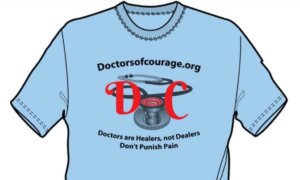 Get your T-shirt to tell the world the truth about pain and the War on Doctors! Doctors of Courage is the ultimate source for information people need to know.
Help Stop the Propaganda! Wearing the T-shirt opens up the doors of communication.