
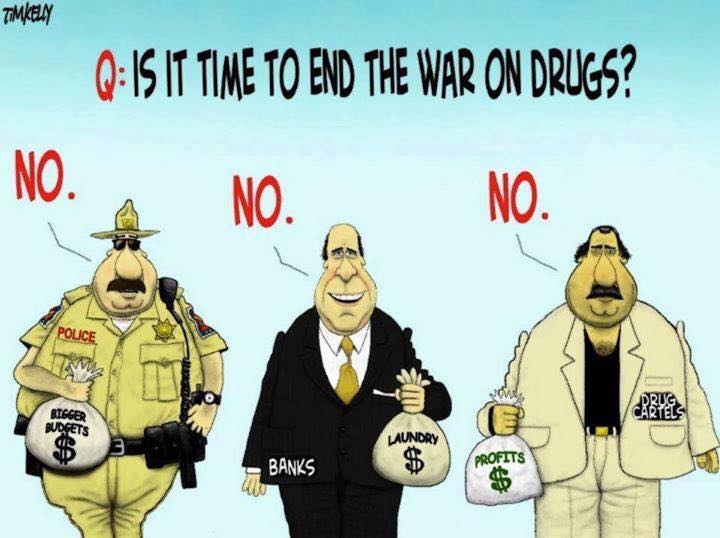
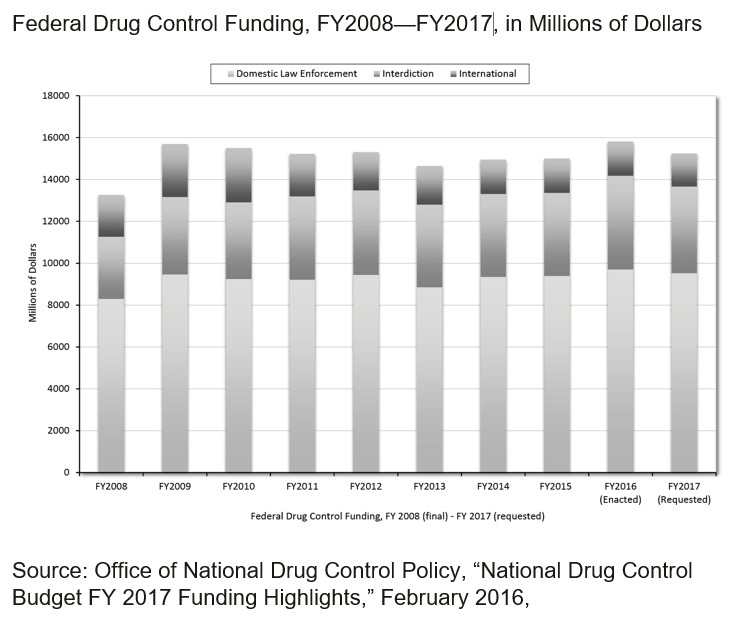
In 1973, the federal drug enforcement budget was a fraction of today’s. It has since grown by 3,300 percent, with about $40 billion per year now spent to enforce drug prohibition. Arrests for drug offenses have increased nearly 380 percent since the war began, but the supply, purity, and diversity of drugs on the market have only expanded.
Even by its own metrics, the system is inefficient beyond belief. In 1997, Rolling Stone exposed that the U.S. drug war was being executed by 44 federal agencies, each operating with separate budgets and intelligence networks, and no unified management or oversight. While the so-called “drug czar” led a staff of just 150 employees, the federal drug war budget totaled $16 billion — half of it going to prisons. Today, nearly 50 federal agencies share a combined $46 billion in drug war funding, with the ONDCP controlling less than one percent. This is not government efficiency — it’s bureaucratic chaos funded by taxpayers.
The cost isn’t just financial. According to the Alternative World Drug Report, global enforcement of drug prohibition costs at least $100 billion each year. It hasn’t eliminated supply or demand; instead, it has:
- Created a vast criminal market worth over $330 billion globally.
- Diverted resources from health care to policing.
- Shifted production geographically (“the balloon effect”) without reducing overall supply.
- Fueled corruption, money laundering, and violence worldwide.
- Stigmatized and marginalized people who use drugs rather than providing treatment or support.
Even the UN Office on Drugs and Crime (UNODC) admits these are “negative unintended consequences of the current enforcement-led approach.”
The economic and moral disaster of drug prohibition mirrors the earlier failure of alcohol prohibition. Crime and corruption exploded under the Volstead Act; the murder rate rose during its enforcement, then fell every year after its repeal. The same pattern haunts us today: the criminalization of drugs has inflated prices, empowered organized crime, overcrowded prisons, and broken families, without achieving its core goal — reducing drug use.
Meanwhile, public health programs remain chronically underfunded. In 2003, 53% of the U.S. drug-control budget went to enforcement, while only 29% funded treatment and 18% prevention. By 2023, enforcement spending still dwarfed health-based solutions. The DEA alone requested $3.7 billion for 2024, citing the fentanyl crisis as justification — the same crisis created in part by decades of failed prohibition that pushed users toward stronger black-market synthetics.
The Controlled Substances Act has become a monument to policy failure. It codified outdated classifications, stifled medical research, and criminalized hundreds of thousands of nonviolent citizens. It is the legal engine behind mass incarceration, systemic racial disparities, and the erosion of civil liberties.
Fifty years and a trillion dollars later, we must ask: what if ending prohibition worked better than enforcing it?
Repeal of the Controlled Substances Act would not mean lawlessness—it would mean shifting from punishment to regulation, from fear to science. It would allow evidence-based drug education, medical research, and public health systems to replace militarized enforcement. It would end the costly illusion that criminalization ensures safety.
The war on drugs has never been about drugs; it has been about control. Ending it is not just cost-effective — it’s a moral imperative.
My wife is an AML Leukemia survivor but her scar from it is very bad peripheral neuropathy from the knees on down in both legs. She has tried many therapies, some Johns Hopkins clinical trials, etc. but the pain exists. It is life changing. For five years she has been using Tramadol three doses a day. It is the difference between sitting on the couch all day, doing nothing and crying, to having pain that is tamped down enough to get up and go about some form of life.
Her PCP retired and a new, very young MD took over and wasn’t going to renew my wife’s prescription. My wife went through 6 days without any pain meds and finally got in to see the doctor. During those six days she was in too much pain to go and sit on the patio to watch the deer in the yard, etc. The doctor said that she is willing to prescribe but only if my wife comes in more often. In the doctor’s last State of residence she required monthly visits but will accept every three months. We are retired and even though it is more than she would want, we can do it. If my wife still worked it would not be as easy. The doctor said if she doesn’t like it, she is free to find a new doctor.
The new doctor mentioned her DEA registration and she doesn’t want to lose it, etc. So this is all about everyone else except the patients pain. Seems a bit cruel. And forcing a a patient that is in pain to monthly “hello” visits is cruel and not needed. In 1971 Nixon’s administration started this nonsense and it is time to end it. If my wife had a choice, she would never have asked for Leukemia nor chronic pain. Then add in the governments cruel attitudes about medications and pain….it makes me angry.
Well, the answer is here on Doctorsofcourage, to get the CSA repealed and the threat ended, but people just won’t learn and pass it on, so I’m afraid the suffering will continue. But if you are interested in helping get appropriate pain management back, learn what I teach and teach others, including your doctors.
I totally agree as a 68 year old intractable pain patient who has had 6 spinal surgeries. Both shoulders replaced and left knee replaced. I have several autoimmune diseases. I am miserable now that my pain doctor has involuntarily reduced my pain medication by 60 %.
All I want at this point, is to die, for pain relief. I am only holding on for my son and husband. The don’t have to endure every second of my pained life. I often ask, “what kind of country treats their citizens like this”? We are portrayed as wimps when in fact the strength it takes to continue living with ever progressive diseases with no cure. No matter how worse our pain gets we will only get less and less medication. Our medical society should at least offer us an assisted end of misery. They do if you have 6 months or less but not if you have numerous diseases that will last a life tie. How cruel is this thinking. Thanks for your work. Sharon woodenship02@yahoo.com
Thank you, Dr. Cheek, for this clear-eyed, courageous, and deeply necessary article. It is rare to see the War on Drugs examined with such clinical honesty—measuring results rather than intentions, outcomes rather than slogans.
Your restrained use of data is especially powerful. The numbers are not deployed for shock value; they function like lab results that make denial impossible. The comparison to alcohol prohibition is both historically sound and morally clarifying, reminding us that failed policy patterns repeat when we refuse to learn from them.
I was also struck by your exposition of bureaucratic fragmentation and the enormous cost of enforcement divorced from accountability. It explains, with unsettling clarity, how inefficiency becomes institutionalized and protected.
Most important, the article restores humanity to a conversation long stripped of it. By naming stigma, mass incarceration, and the erosion of civil liberties as foreseeable consequences—not collateral damage—you reframe drug policy as a public-health and ethical issue, where it belongs.
This reads like a long-overdue chart review of a national policy that has caused more harm than healing. Your call to replace punishment with science, regulation, and care is not radical—it is responsible. An outstanding contribution that deserves serious attention and thoughtful discussion.
Thank you so much, Dr. Arshad, for your summary of the post. I just hope more people understand the need to repeal the CSA, and get behind the movement. There are more posts to follow, each focusing on a different aspect of living that the CSA has an effect on. Enjoy.